Podcast
Sustainability at Travelers with Yafit Cohn

In this episode of the Travelers Institute Risk & Resilience podcast, Travelers Institute President Joan Woodward and Travelers Chief Sustainability Officer Yafit Cohn discuss the meaning of sustainability in the corporate context. They explore Travelers’ approach to sustainability, how it may differ from that of other companies, and how our business strategy and performance are inextricably linked with the Travelers Promise to take care of our customers, our communities and each other. The conversation also covers what goes into producing the annual Sustainability Report and includes key highlights to watch for this year.
JOAN WOODWARD: Hi, folks, and welcome back to the Travelers Institute Risk & Resilience Podcast. I'm your host, Joan Woodward, President of the Travelers Institute. In this episode, I'm joined by Yafit Cohn, Travelers' Chief Sustainability Officer, really for a great conversation about sustainability in the corporate context. We discussed Yafit's role and how Travelers views sustainability compared to other companies. We also talked about communicating priorities to stakeholders and the evolution of the annual report, and what to expect moving forward. I learned a lot in this conversation and I really think you will too. Take a listen.
I'm thrilled to be here with my colleague and friend, and Travelers' Chief Sustainability Officer and Group General Counsel, Yafit Cohn. Prior to coming to Travelers in 2017, Yafit was counsel at Simpson Thacher's New York office and a member of the Public Company Advisory Practice. There she advised public companies, corporate management and boards of directors on a broad array of issues pertaining to securities law and corporate governance. So, before we get started into our conversation, I'm just going to take a moment to probably embarrass her a little bit and read off just a few of her recent accolades, because they really speak to your expertise and leadership in the area of sustainability, Yafit. So bear with me, and there's a lot more, folks. I'm just giving you some highlights.
Just in the last few years, you've been named to the list of insurance executives to watch by Risk & Insurance. You've received Corporate Counsel's Women, Influence & Power in Law Award. You've been included on the Insurance Business Global 100 list. You've been named to the Top 250 Women in Sustainability by Sustainability Magazine, and you were included on the Insurance Business America's Hot 100 list. And Yafit, that Hot 100 list and the word insurance in the same sentence always just puzzles me, but here it goes. So it goes without saying, folks, we're very lucky to have you as part of our team here at Travelers, our senior leadership team, and I'm really excited that you're joining me today, so welcome.
YAFIT COHN: Thank you so much. I really appreciate being on.
JOAN WOODWARD: So, let's get started. Generally, what does sustainability mean, and how does Travelers think about it, maybe even differently than some companies?
YAFIT COHN: Yeah. I think that's a great question and probably the right question to start with, because it really doesn't have a universally agreed-upon definition, and that's been one of the challenges with ESG or sustainability. I use the terms interchangeably. One of the things that I did when I first got started at Travelers in 2017 was to try to figure out what it means for Travelers to try to articulate that definition, and I did that after having a lot of conversations with investors and other people in the know. And where I landed, honestly, for myself and for Travelers is that sustainability is about risks and opportunities. It's about thinking holistically about the risks and opportunities that could potentially impact a company's ability to create shareholder value over the long term, and how the company manages those risks and takes advantage of those opportunities for the purpose of ensuring its own long-term economic success.
So, it's really about a holistic approach to value creation, and it's also recognition of what Travelers and many other companies have long understood, which is that they can only create shareholder value over time if they also take care of their other stakeholders. In our case, we say, "To fulfill the Travelers Promise, taking care of our customers, our communities and our employees." So, all of that is to say that when you think about sustainability, it's really, at least for Travelers, about value rather than values. And when you go onto our sustainability website, you can see that philosophy front and center on the site.
You could see that in Alan Schnitzer, our CEO. He has a message on that site to introduce the site, and what he explains and what we explain on the site is that for Travelers, sustainability, or our long-term success, requires that we do three things successfully. It requires that we perform, in other words, continue to execute on our long-term financial strategy, transform, meaning innovating for tomorrow and make good on the Travelers Promise that I mentioned, and that's the reference to our commitment to taking care of our customers, our communities and each other. So, sustainability is really not separate and apart from the way we do business. It's actually essentially our long-term value creation strategy. And so, every facet of our business is linked to sustainability, and every employee, regardless of their level or role, plays a part in creating sustained value at Travelers.
JOAN WOODWARD: OK, great. So, is sustainability something new, then, for Travelers?
YAFIT COHN: No, not at all. It's actually something that's always been embedded within our business strategy, and it's just something that we've always understood. So, if you think back to the definition that I gave, we've always understood that we need to think broadly when it comes to risk, and we need to be forward-thinking in terms of opportunities and innovation if we want to stay competitive in the market. And when I think back to 2019, which is when we first published our first Sustainability Report, it was over 200 pages long. It had a tremendous amount of information, as it still does today, but there was not a single initiative or program that we had created specifically for inclusion in that Sustainability Report. I was really just collecting and conveying everything we were already doing as a company and describing our holistic and integrated approach to sustained value creation.
JOAN WOODWARD: Tell us about your role as Chief Sustainability Officer, then.
YAFIT COHN: There's actually a lot to say there. I guess I'll get started by saying, as you know, Joan, I'm an attorney by way of background. I started my career in securities litigation and government investigations, and I later pivoted to focusing on securities disclosure and corporate governance. And back in 2017, when ESG was the latest frontier in corporate governance, I was asked to join Travelers to help guide the company through the increasingly complex and continuously evolving ESG landscape, and also to help the company create thoughtful and comprehensive sustainability reporting. So at the time, there was this feeling that the company was doing so much and has such a compelling story to tell around value creation that incorporates relevant environmental, social and governance factors, but at the time we hadn't yet packaged it for public consumption, and we thought there was this really important opportunity to be proactive and tell our story rather than having that story be told for us, whether it was by investors or by ESG rating firms.
So, a meaningful part of my role still today relates to effectively communicating our sustainable business strategy. So obviously, that includes our annual sustainability reporting, but on top of that, I engage regularly with our large institutional investors and I speak with our other stakeholders, for example, the two major proxy advisory firms, regulators, special interest groups and other groups as the need arises. And then coming back to that constantly evolving ESG environment, we do have, as you know, a management level multidisciplinary Sustainability Committee at Travelers, and I chair that committee. So we've got people from so many disciplines on that committee, accounting, risk, finance, underwriting, legal, HR, etc. And in those meetings, we discuss relevant developments, we brainstorm approaches to certain issues, and ultimately through those meetings, I help to make sure that we're all rowing in the same direction as it pertains to environmental, social and governance matters relevant to the company.
I also liaise closely with our government relations team and weigh in as necessary on ESG-related legislative or regulatory developments that could impact the company. And then on top of all of that, I speak with various groups of employees around the company. I've been spreading the word internally about our approach to sustainability. I always invite employees to share their thoughts and ideas with me. And in those conversations, I really like to highlight the fact that because sustainability is integrated within our business strategy and our day-to-day operations, many initiatives that we discuss in our Sustainability Report actually originated from ideas of employees in every part of the organization. So, I would say that's the role in a nutshell.
JOAN WOODWARD: That's certainly a lot, and what I love most about what we just said was really how we engage our employees and embed this into all of our businesses. And every one of our employees, I think, has a role to play in sustainability and what they're doing.
YAFIT COHN: Yes.
JOAN WOODWARD: The fact that they're making suggestions to you about things they see in the world and things they might want to implement here, I just think it's so terrific. So I do sit on the Sustainability Committee and I watch how you're operating, and I'm just so proud that we have built such a world-class department.
YAFIT COHN: And you know, we consistently get positive feedback from our investors as well, and that's been a real measure of our success, I think. But as you know from those committees, the role has also evolved in a way, because there's just so much more pressure on public companies from a variety of ESG rating organizations and for-profit and not-for-profit groups, each of which has its own areas of interest and goals and views, so think about environmental groups, religious organizations, assorted investors that have a socially responsible bent. And so, as that ESG ecosystem has continued to expand over the years and you've got all these new entities trying to get in on the ESG action, it just feels like it's been all the more important for a chief sustainability officer at a public company to be conversant in the area and to be able to soundly guide the company with respect to where to direct management attention and spend limited resources.
And I'd like to come back to what I said earlier about the widespread confusion about the definition of the term sustainability or ESG, because I think that's part of the problem. When you think about the fact that putting aside the mainstream institutional investors, like asset managers, that obviously view specific ESG issues as risks that could impact their investments, and if you put aside customers and employees who appreciate companies that are doing well by doing good, there are all these groups that have been pushing public companies to address various environmental, social and political issues that are really unrelated or even detrimental to shareholder value. And they've latched onto that term, ESG, to influence companies to advance their public policy goals, and that ultimately blurs the line between value and values.
And I'll share too that over the last few years, the pressure on public companies has come from shareholder proponents and other activists on both sides of the political aisle, so that dynamic really gives rise to a monumental challenge for companies and by extension chief sustainability officers that are advising those companies. So, it's really become a very important part of my job to help guide the company in the face of all those pressures.
JOAN WOODWARD: Let's stay on that topic for a moment. So, given the current environment, have you made any changes in your approach to sustainability?
YAFIT COHN: That's a great question and a question that we've gotten from other stakeholders as well, and I would say no. We are and we've always been laser-focused on the fact that we're stewards of our shareholders' capital. So, our corporate decisions now and before are really based on an evaluation of whether the action that we're considering will increase shareholder value over time, and of course, recognizing that that requires us to fulfill our promise to take care of our customers, our communities and each other. So, whenever we're asked to take on certain actions, we evaluate first and foremost what's in the best interest of the company and its shareholders over the long term? We prioritize the company's key risks and opportunities, and we focus on what I would call shared value, which are efforts that are good for the company and its long-term shareholders on the one hand, but also good for other stakeholders.
JOAN WOODWARD: So actually, can you give us just maybe a few examples of what you mean by shared value?
YAFIT COHN: Yeah, absolutely. One example that comes to mind is our Early Severity Predictor model, which we use in our workers compensation business to help identify an injured employee's likelihood of experiencing chronic pain. So, by adjusting medical care and resources, that Early Severity Predictor model can help address potential drivers of chronic pain, which is often treated with opioids or other painkillers, and that ultimately reduces the risk of opioid addiction. So, the Early Severity Predictor helps injured employees while also reducing Travelers' opioid-related claim costs.
JOAN WOODWARD: OK, so let's talk about our very first Sustainability Report, as you say, was in 2019. So, tell us a little bit more about what went into actually creating that first report.
YAFIT COHN: We got started in late 2017, and what I did when I first got started is I spent months engaging with our investors to get their views with respect to sustainability reporting. And I really wanted to understand how our investors were getting their information, what they wanted to see in a sustainability report from a P&C insurer like Travelers, what topics they thought would be most important, whether they had a preference for certain frameworks or standards for disclosure, and what they considered to be hallmarks of strong sustainability reports. And ultimately, I spoke to investors representing almost 50% of our shares outstanding at the time. Now, in addition to those engagements, we also conducted what we call a prioritization exercise internally to help focus our reporting on the topics most relevant to our industry, our business and our stakeholders, and that exercise involved a series of internal group discussions, each of which was dedicated to a distinct stakeholder group, investors, customers, employees, agents and brokers and even Travelers itself.
And ultimately, the result of all those conversations and that prioritization exercise was that we identified 16 distinct topics that we call our key drivers of sustained value at Travelers. In other words, all of those topics taken together ladder up to our successful financial performance. So, one of the things that I've always appreciated about those 16 drivers of sustained value and that I like to point out to people is that they include topics that you would expect to see as drivers of sustained value at a public company, like capital and risk management, investment management and governance, but they also include topics that others might label ESG, like climate strategy or human capital management, but really at Travelers, they're just part of the value creation mosaic.
So in any event, once we had all the topics that we were going to report on, it really took a village to compile that first report. And because sustainability, as I mentioned, is truly integrated into our business, and because we really wanted to provide a holistic and comprehensive view of how Travelers creates value over time, the information that we needed for our sustainability reporting really resided throughout the organization, from accounting to finance to underwriting to the Travelers Foundation and the Travelers Institute. And there was so much information to collect from so many different people that it really was a monumental effort. It ultimately involved well over 100 Travelers employees, all of whom are subject matter experts in different disciplines.
So, once we collected all that information that we needed, the final question that we grappled with was, how do we bring all of this to life? How do we convey our value creation story? And one of the things that we heard from our investor conversations was that investors are often less appreciative of sustainability reports that try to reach multiple audiences, and they're not as interested in what I would call human interest stories or discussions of philanthropic efforts, unless we can draw a direct connection to the business and to shareholder value. And relatedly, what we heard from many investors is that best-in-class sustainability reports demonstrate how environmental, social and governance issues are integrated into the business, and they describe the benefits to the company from the various initiatives that's engaged in. So, all of that really fit perfectly with the integration of sustainability into our own business. And so, the way that we approached our reporting was to integrate to the best of our ability disclosure regarding each of our 16 drivers of sustained value with a discussion of our long-term strategy for value creation.
And then separately, based on discussions we had with investors, we decided to issue two stand-alone reports that generally align with two well-known sets of standards or frameworks. One is the Sustainability Accounting Standards Board, or SASB, standards for the insurance industry, and also the recommendations of the task force on climate-related financial disclosures for TCFD. Both SASB and TCFD have the investor audience in mind, and we heard significant interest from our investors in that reporting, and I'm proud to say that we're among the first in our industry to provide both SASB and TCFD reports.
JOAN WOODWARD: I just can't say enough about how the framework for thinking about sustainability here is just, I think, so unique in corporate America. And I don't know if others are heavily looking into these issues of sustainability or ESG, but I think the framework that you describe and the reporting, the reporting takes a lot of time, of course. Let's talk a little bit about that. So, what goes into actually producing that report each year?
YAFIT COHN: Well, it's a really long process. It's essentially a year-long process at this point, and it has so many moving pieces and involves about 200 subject matter experts from all over Travelers today. And then as we get closer to publication, the language is vetted and confirmed by our relevant internal subject matter experts, and then it's reviewed by our Disclosure Committee and the Sustainability Committee that we were just talking about. And then we also work closely with our partners in legal and finance to help make sure that all of the information in each of our reports is accurate and complete in all material respects, and we have a process that we go through, by which subject matter experts certify the information in the reports. So, I do think it's very thoughtful. I'm not sure every company goes through those efforts. Honestly, it's a Herculean task for a company that accomplishes as much as Travelers does in one year and has such robust reporting.
JOAN WOODWARD: OK, so what are a few things in the report that we should look out for? And by the way, what month is the report published? And lastly, were you surprised by anything?
YAFIT COHN: The Sustainability Report is hot off the press. We just launched it in mid-June, and I would say I really wasn't surprised by anything. I've been doing this for six years at this point, so I'm really not surprised by all the incredible work that my colleagues do to continue to deliver industry-leading returns year after year. But I can share a few highlights from this year's report. On the environmental side, you know that a few years ago we made a commitment to become carbon-neutral in our owned operations by 2030. At this point, we've reduced our Scope 1 and Scope 2 emissions. Those are the emissions that we have control over. We've reduced those emissions by 55% since 2011, so we're making progress toward that commitment.
It's also worth noting that we expanded our climate scenario analysis this year, and let me back up and explain what climate scenario analysis is for those who don't know. That's a process of assessing potential impacts on the company as a result of a number of hypothetical future climate conditions. And so a number of years ago, we were, again, either the first or among the first domestic P&C insurance companies to conduct and disclose the results of a climate scenario analysis. Now, since every weather peril is unique, we have to perform climate scenario analysis on a peril-by-peril basis. So when we got started, we started with the hurricane peril, but then in 2024, what you'll see in the report is that we expanded that climate scenario analysis to include wildfire, so that's pretty significant.
Beyond climate, let me just share three more quick examples of what's in the report. First, in 2024, we were again able to adjust nearly all of our catastrophe claims with our own employees. That's something we're really proud of, and it's a differentiator for Travelers. Second, over the past decade, Travelers and the Travelers Foundation have provided more than $237 million in gifts to local communities. And then finally, our report highlights a new program that's called SaveMyRide, which offers our personal insurance customers free parking at a safer location to protect their vehicles from an impending hurricane or tropical storm. And what's cool about that idea is that not only is it innovative, but it was developed during what we call our InJam, which is our annual ideation event, and it was then executed in partnership with our claim team.
So, coming back to my examples earlier of shared value, this is a great example of that too. Our customers are more at ease knowing that their vehicle's in a safer location during the storm, and the company saves money in loss costs. So, those are a few examples of what you'll find in our 2024 Sustainability Report. But as I mentioned, the report is huge, and there's so much in there, so I would encourage everyone listening to explore the full report, and that's on our website at sustainability.travelers.com.
JOAN WOODWARD: I look forward to reading it. There's something for everyone in it. It really is so comprehensive, well-organized and just so thoughtfully done. So listen, Yafit, you're a busy lady, that is for sure, and we just so appreciate you stopping by our podcast and would love to invite you back, maybe on an annual basis to give us an update on what's new. The world changes. It's so unique, I think, that when you talk about creating shared value for all investors and stakeholders, it's embedded in the business. And I think a lot of people don't think about that in sustainability land and other companies maybe, and so it really is a unique perspective, and we're just so thrilled and we're honored, and we're lucky to have you, such a thought leader in the industry for us. So, thank you for coming. Please, please, please come back, and just keep going. It's just amazing.
YAFIT COHN: Thank you, Joan. The privilege was mine.
JOAN WOODWARD: Thank you for listening to this insightful conversation. Check out our show notes for more information about the Travelers Institute and to sign up for our mailing list. We send updates on upcoming podcasts, webinars, in-person events and more. I'd also love to hear what you thought about today's episode and what topics you'd like us to cover in the future. You can shoot me a note at [email protected], or follow me on LinkedIn and send me a message there as well. Thanks so much for tuning in.
This episode is also available on Apple Podcasts®.
Subscribe

Speaker
Yafit Cohn
Chief Sustainability Officer, Travelers

Host
Joan Woodward
President, Travelers Institute; Executive Vice President, Public Policy, Travelers
Key takeaways
- Travelers defines sustainability as managing risks and opportunities that could impact long-term shareholder value, focusing on “value rather than values.”
- Sustainability at Travelers goes beyond environmental issues to include corporate strategy, community support, long-term resilience and more.
- Sustainability isn’t separate from Travelers’ business strategy, but rather embedded in its daily operations, with every employee playing a role in creating sustained value.
- Travelers’ long-term success requires that it continue to do three things successfully: perform (execute on its long-term financial strategy), transform (innovate for tomorrow) and make good on the Travelers Promise – a commitment to take care of customers, communities and each other.
- Travelers prioritizes initiatives that benefit both shareholders and other stakeholders, such as the Early Severity Predictor® model, which helps injured workers while reducing claim costs.
Travelers Institute Risk & Resilience podcast
Subscribe on LinkedIn® (Opens in a new window)
The Travelers Institute Risk & Resilience podcast is available on Spotify and Apple Podcasts®. Subscribe today to be alerted when new episodes are released.
Explore more
Overload: How Employers Can Help Maxed-Out Caregivers
With 53 million Americans providing unpaid care for loved ones and many contemplating reducing hours or leaving jobs entirely, caregiving has a transformative impact on America's workforce. Lindsay Jurist-Rosner, co-founder and CEO of Wellthy, joins Travelers' Greg Landmark to explore how employers can help families navigate the complexities of caregiving while retaining talent and boosting productivity.

Live from Claim University: Behind the Scenes at Travelers' Flagship Educational Hub
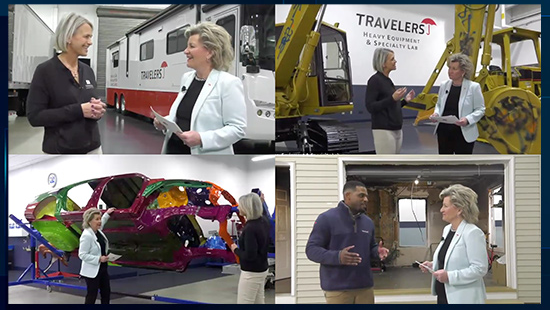
In this webinar, we got an exclusive tour of Travelers’ 200,000-square-foot Claim University. We saw where our Claim employees gain hands-on experience with property, auto, heavy equipment damage, medical and liability scenarios and explored the immersive learning labs.
100th Episode with Special Guest Alan Schnitzer
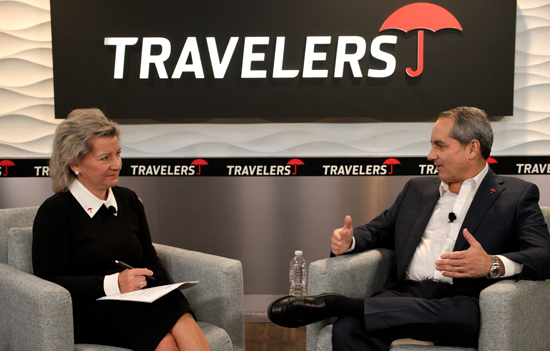
What makes a successful leader during times of uncertainty and rapid change? Travelers Chairman and Chief Executive Officer Alan Schnitzer joined us for a conversation on leadership.
In the news
PropertyCasualty360
Insurance Business Magazine
Utah Independent Agents
Join our mailing list
Invitations, event announcements, replays and more — delivered to you.
Sign up